
By your 40s, your muscles are already starting to fade - not from lack of effort, but from time. This isn't just about getting weaker. It's about losing the ability to stand up from a chair, carry groceries, or catch yourself if you trip. That’s sarcopenia: the slow, silent erosion of muscle mass and strength that comes with aging. And it’s more common than you think. About 1 in 10 adults over 60 have it. By 80, that number jumps to nearly half. It’s not normal aging. It’s a medical condition. And the good news? You can fight it - with the right kind of training.
What Exactly Is Sarcopenia?
Sarcopenia isn’t just feeling tired or out of shape. It’s a measurable decline in skeletal muscle, defined by three things: less muscle mass, weaker strength, and slower movement. The European Working Group on Sarcopenia in Older People (EWGSOP) set the official standards: if your handgrip strength falls below 27kg for men or 16kg for women, your walking speed drops under 0.8 meters per second, or your lean muscle mass per square meter of body height is below 7.0kg for men or 5.5kg for women - you’re likely dealing with sarcopenia. These aren’t guesswork numbers. They come from DXA scans, grip tests, and timed walks - the same tools doctors use to diagnose it.
This process starts quietly. Muscle loss begins in your 30s and 40s, but it’s so gradual most people don’t notice until their 60s or 70s. Then, it accelerates. Between ages 65 and 80, you can lose 1-2% of your muscle mass every single year. That’s not just a little weaker. It’s enough to make stairs unbearable, bathing risky, and falling a real threat. And once you start falling, your independence starts slipping away too.
Why Does This Happen?
Your body isn’t broken - it’s just aging. But that aging follows a clear pattern. After 60, you lose about 3-5% of your motor neurons each year. These are the wires that tell your muscles to move. Fewer wires mean fewer signals, and weaker contractions. Your fast-twitch muscle fibers - the ones that let you jump, sprint, or lift quickly - shrink by 30-40% by age 80. Meanwhile, your body’s ability to repair muscle drops by 50-60% because satellite cells (your muscle’s repair crew) slow down.
At the cellular level, things get even more complicated. Your muscles struggle to use protein efficiently. Protein synthesis rates drop by 20-25%. Mitochondria - the power plants in your cells - produce 15-20% less energy. And chronic, low-grade inflammation rises. Levels of IL-6 and TNF-alpha, inflammatory markers, go up by 30-50% in older adults. All of this adds up: less fuel, less repair, less signal, less muscle.
And here’s the kicker: sarcopenia isn’t the same as general muscle loss. If you’re bedridden after surgery, you lose muscle fast - up to 1.5% per day. That’s disuse atrophy. Cachexia is muscle loss from cancer or severe illness, often with weight loss and metabolic chaos. Dynapenia is just strength loss without muscle mass loss. Sarcopenia? It’s the full package: mass, strength, and function - all declining together.
The Real Cost of Losing Muscle
It’s not just about fitness. It’s about survival. People with sarcopenia are 2-3 times more likely to fall. Falls are the leading cause of injury-related death in older adults. Hospital stays, fractures, long-term care - it all adds up. In the U.S. alone, sarcopenia costs $18.5 billion a year in medical bills. That’s more than diabetes complications or heart failure hospitalizations in some years.
And it’s not just physical. Losing muscle means losing independence. You stop cooking because you can’t lift the pot. You stop walking because you’re afraid of falling. You stop going out because you can’t carry your purse. A 2022 survey of over 3,000 older adults found that 75% who did regular strength training kept their independence in daily tasks. Only 58% of those who didn’t train could say the same.
Strength Training: The Only Proven Fix
If you’ve heard that lifting weights is for young people, forget it. The science is clear: strength training is the single most effective tool we have to stop - and even reverse - sarcopenia. A 2012 review by Dr. Jeremy Walston at Johns Hopkins showed that older adults who started resistance training gained 1-2kg of muscle and boosted strength by 25-30% in just 12 to 16 weeks. That’s not a small gain. That’s enough to open jars, climb stairs, and stand up from a couch without help.
Dr. Anne B. Newman at the University of Pittsburgh found that two sessions a week of progressive resistance training improved walking speed by 0.1-0.2 meters per second and cut fall risk by 30-40%. That’s not just better balance. That’s fewer broken hips, fewer hospital visits, and more years living on your own.
Here’s what works best, based on the American College of Sports Medicine’s 2022 guidelines:
- Train 2-3 times a week - at least 48 hours between sessions so muscles can recover.
- Do 1-3 sets of 8-12 repetitions per exercise.
- Use 60-80% of your one-rep max (the heaviest weight you can lift once).
- Target all major muscle groups: legs, back, chest, shoulders, arms, core.
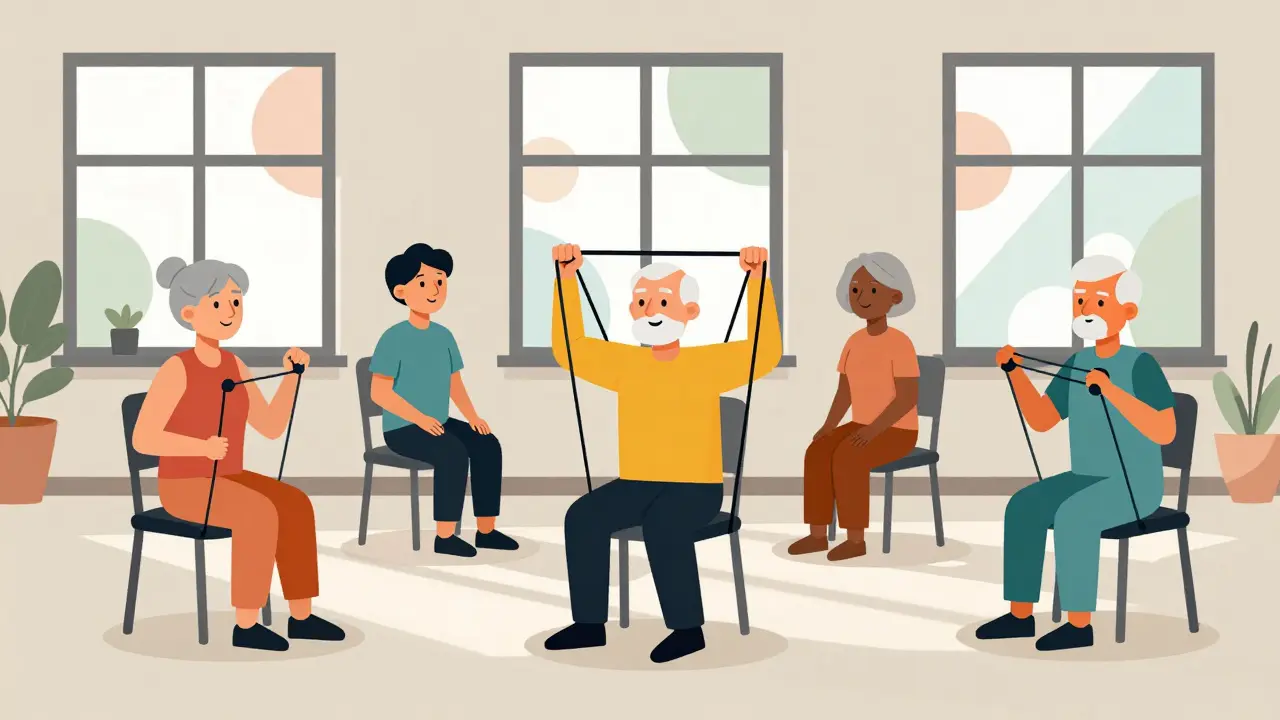
You don’t need a gym. You don’t need heavy weights. You need consistency. Start with bodyweight moves: chair squats, wall push-ups, seated shoulder presses with resistance bands. Then, as you get stronger, move to machines or dumbbells. The goal isn’t to look like a bodybuilder. It’s to keep your body working.
What Gets in the Way?
People want to train. But they don’t always know how - or where to start. A 2022 National Council on Aging survey found that 34% of older adults struggled to find age-appropriate programs. Another 27% said the cost was too high - $50 to $75 a month for specialized senior training isn’t cheap.
Then there’s the pain. About 35-40% of beginners report joint discomfort, especially in knees or shoulders. That’s why starting slow matters. Use machines with limited range of motion. Do seated exercises. Use resistance bands instead of heavy dumbbells. Pain isn’t a sign to quit - it’s a sign to adjust.
Motivation is another hurdle. People quit when they don’t see results fast. But muscle growth takes time. The real wins come in small moments: lifting a suitcase without help, walking up a hill without stopping, standing up from the floor without using your hands. One 68-year-old man on MyFitnessPal posted: “After six months, my handgrip went from 18kg to 24kg. I could open jars again.” That’s not vanity. That’s freedom.
And social support helps. People who train in groups stick with it 35-40% longer than those who go alone. Look for SilverSneakers, a Medicare Advantage program used by over 4 million seniors. It’s free, widely available, and built for older bodies.
How to Start - Even If You’re New
If you’ve never lifted a weight, here’s a simple path:
- Weeks 1-4: Do bodyweight exercises 2 days a week. Chair squats (sit to stand), wall push-ups, seated leg lifts, standing calf raises. Three sets of 10-15 reps each. Rest 60 seconds between sets.
- Weeks 5-8: Add resistance bands. Use light bands (TheraBand yellow or red). Do band rows, band shoulder presses, band bicep curls. Same rep range. Focus on slow, controlled movement.
- Weeks 9-16: Move to machines at the gym or community center. Start with leg press, chest press, lat pulldown. Use 50-60% of your max. Increase weight by 2.5-5% every week.
Don’t skip protein. After training, eat 20-30 grams of protein within 45 minutes. That’s a chicken breast, a protein shake, or a cup of Greek yogurt. Your muscles need it to rebuild.
And breathe. Exhale when you push or lift. Inhale when you lower. Most people hold their breath - that raises blood pressure. Don’t do that.
What’s Changing Now?
The field is moving fast. In 2023, the FDA approved RT001 - a drug targeting mitochondria - for clinical trials. It’s not a magic pill, but it could help those who can’t train. Meanwhile, AI-powered programs like Exer AI give real-time feedback on form, boosting adherence by 25%. Telehealth training - done via video calls - is 85% as effective as in-person sessions, according to JAMA Internal Medicine in 2022. That’s huge for rural areas or people with mobility issues.
But here’s the problem: we don’t have enough people to help. In the U.S., there are only 12,500 certified geriatric physical therapists for 72 million Americans over 65 who will be here by 2030. That’s one therapist for every 5,760 people. That’s not sustainable. That’s why home-based programs, community classes, and telehealth are the future.
You’re Not Too Late
Sarcopenia doesn’t care how long you’ve been inactive. It doesn’t matter if you’re 70, 80, or 90. Muscle responds to load - no matter your age. Studies show even people in their 90s can gain strength and muscle after starting resistance training. The key isn’t intensity. It’s consistency. Two days a week. Slow progress. Good form. Enough protein. That’s it.
It’s not about being strong. It’s about being able to live. To walk to the mailbox. To carry your own laundry. To get up after sitting down. To stay independent. That’s what sarcopenia steals. And that’s what strength training gives back.


Write a comment