
Medication Dosing Translator
Clear Your Confusion
Convert confusing dosing phrases into clear, time-based instructions using health literacy strategies.
Every year, over 1.3 million people in the U.S. are harmed because they don’t understand how to take their medicine. It’s not because they’re careless. It’s because the labels don’t make sense. You’ve probably seen them: small print, confusing phrases like "take twice daily," and units like "mg" and "mL" that look too similar. For many, these labels might as well be written in another language. But there’s a better way - and it’s already working in clinics that use health literacy strategies to cut errors and save lives.
Why Medication Labels Are So Confusing
Most prescription labels still use language written for someone with a 10th-grade reading level. The average adult reads at a 6th- to 8th-grade level. That mismatch is dangerous. A 2009 study from the Journal of General Internal Medicine found that 47% of patients misunderstood instructions like "Take 1 tablet by mouth twice daily." When the same instruction was rewritten as "Take 1 tablet by mouth in the morning and 1 tablet by mouth in the evening," understanding jumped by 15-20%. That’s not a small gain - it’s the difference between getting better and ending up in the hospital.It’s not just about reading. Numbers matter too. Patients with low numeracy skills - the ability to understand and use numbers - struggle with dosing. "Take 5 mL twice daily" sounds simple, but many think it means 5 mL total over two doses, not 5 mL each time. One parent in a 2023 study told researchers, "I thought it meant I should give the whole 5 mL in the morning and nothing at night." That’s not a mistake. That’s a system failure.
What Works: Patient-Centered Labels
The best labels don’t just simplify words - they change how they’re organized. Patient-centered labels use clear, everyday language and structure instructions around real-life routines. Instead of "BID," they say "Take in the morning and at night." Instead of "Q6H," they say "Take every 6 hours." A 2013 study in the Annals of Internal Medicine tested these labels on over 500 adults. The results? A 32% drop in people who accidentally took too much medicine in a single day. But here’s the catch: even with better labels, some errors stayed the same. Patients still took pills too close together or doubled up because they didn’t understand "every 12 hours" versus "twice daily." That’s why labels alone aren’t enough.The Universal Medication Schedule (UMS)
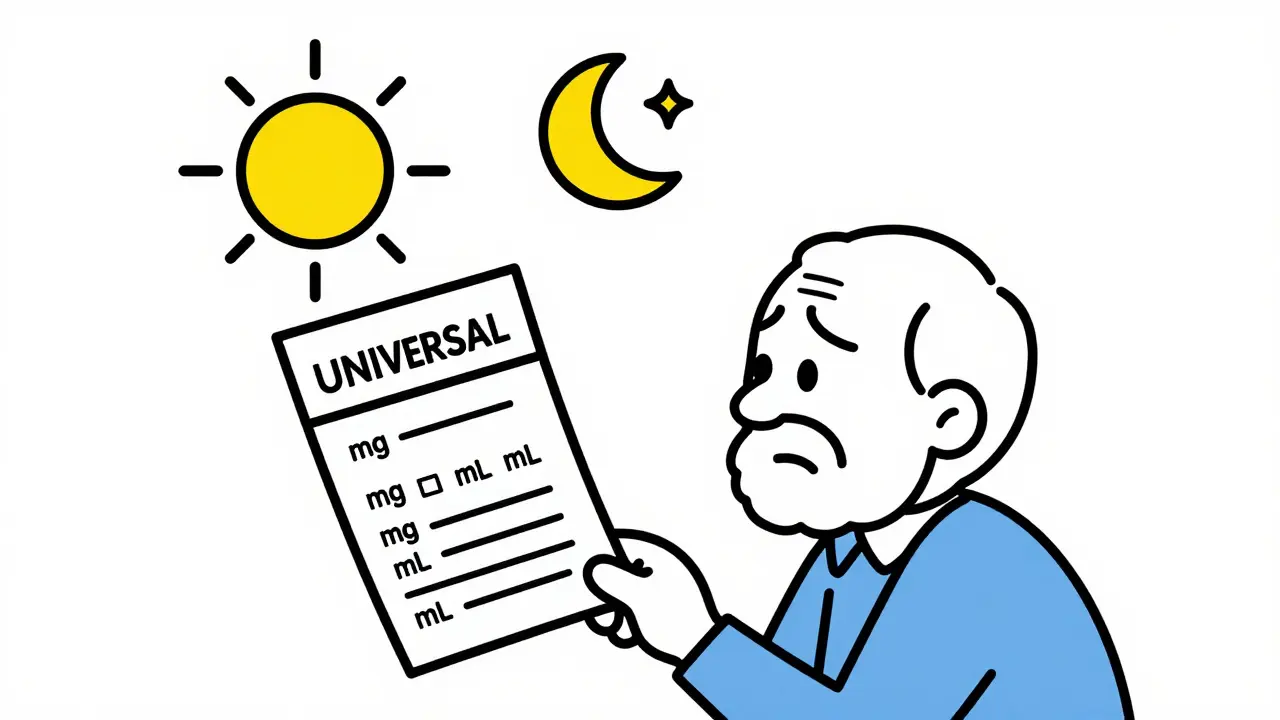
The Universal Medication Schedule (UMS) is one of the most effective tools in use today. It breaks dosing into just four times a day: morning, noon, evening, and bedtime. No more "Q8H" or "QID." If you need to take a pill three times a day, you take it in the morning, at noon, and at bedtime. If it’s twice daily, you take it in the morning and at night.Wisconsin Health Literacy’s 2022 toolkit showed that when clinics switched to UMS, dosing confusion dropped by 47% among older adults taking five or more medications. One 72-year-old patient said, "I finally understood when to take my pills after they switched to morning/noon/evening/bedtime labels." That’s not just convenience - it’s safety.
Visuals That Save Lives
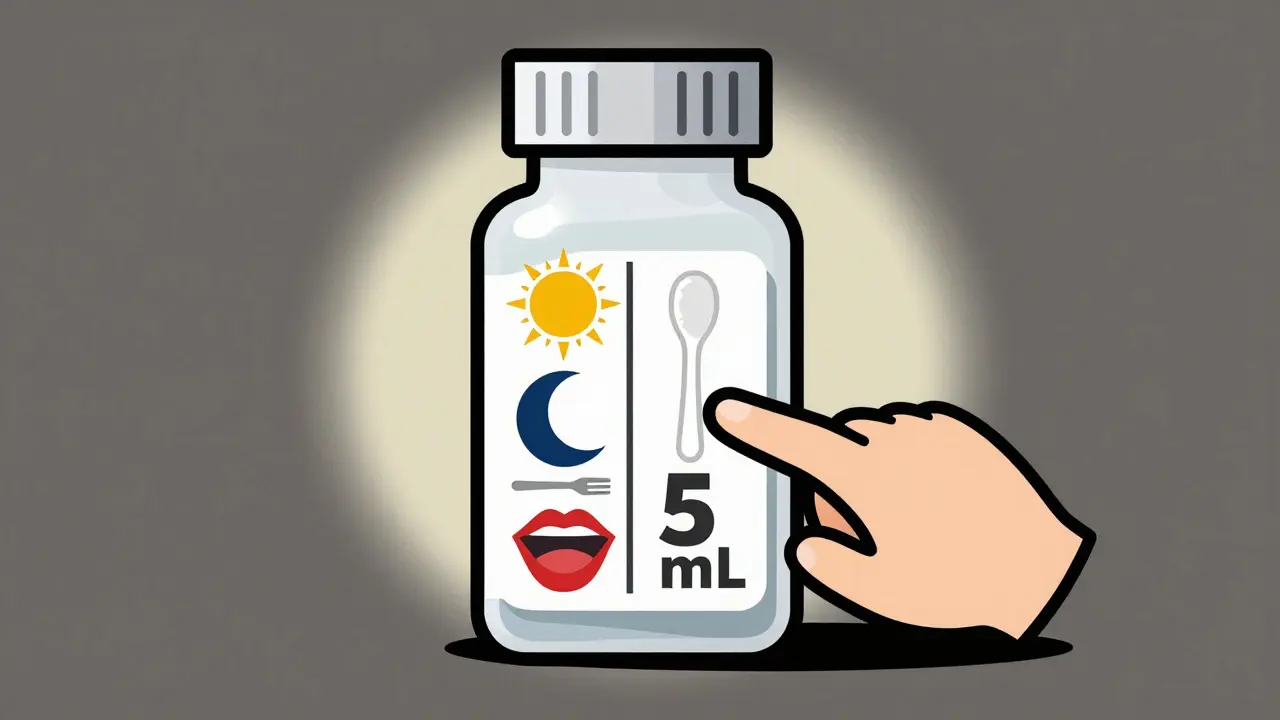
Pictures aren’t just for kids. A 2023 U.S. Pharmacopeia (USP) report found that labels with simple pictograms - like a sun for morning, a moon for bedtime, or a fork for "with food" - increased correct interpretation by 28% among people with low health literacy. These aren’t fancy icons. They’re clear, black-and-white drawings anyone can understand.One case from the Institute for Safe Medication Practices (ISMP) showed a woman drinking albuterol from a plastic container because she thought it was a "syringe." The label didn’t say "oral solution" - it just said "liquid." The pictogram would’ve shown a mouth with a drop. That’s why USP’s new rules, effective in May 2025, now require pictograms on all prescription labels. It’s not optional anymore.
How Clinics Are Making It Happen
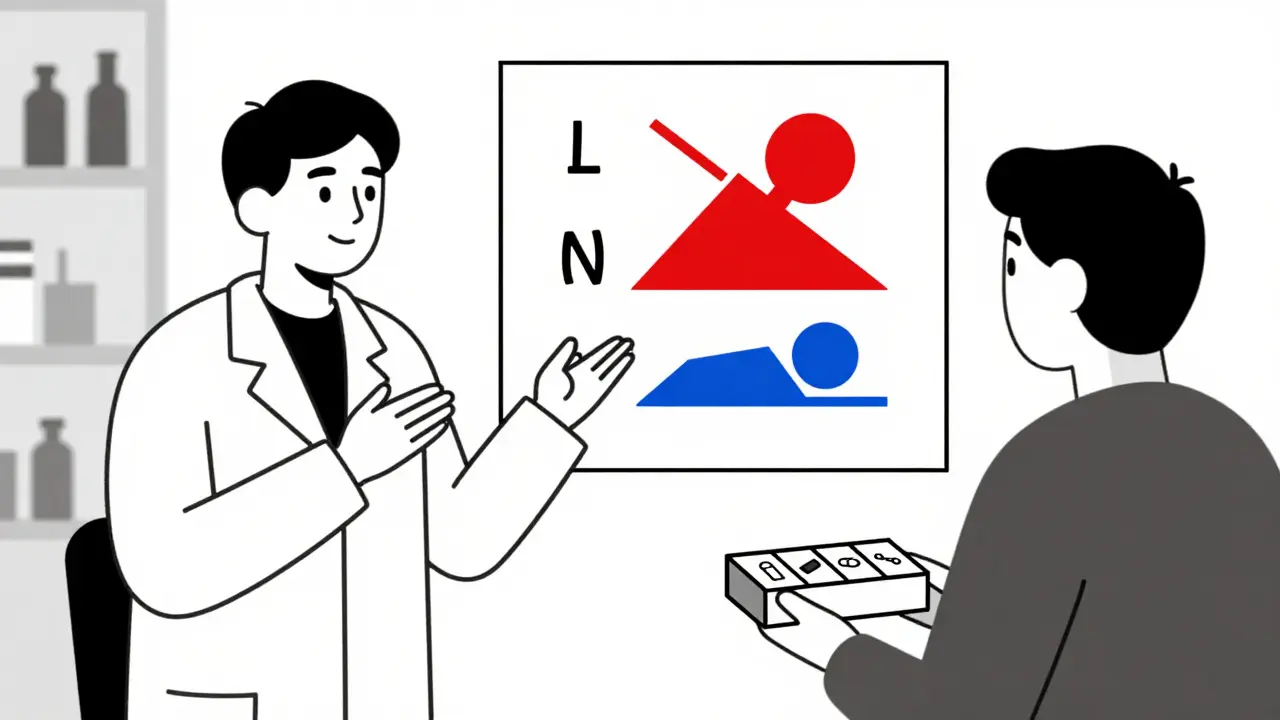
Some clinics are already doing this right. They don’t just hand you a label and say "Read this." They use the teach-back method: they ask you to explain the instructions in your own words. If you say, "I take one when I wake up and one before bed," they know you got it. If you say, "I take two in the morning," they correct you - right then.A 2023 trial at Children’s Hospital of Philadelphia tested this method with caregivers giving liquid medicine to kids. The result? A 34% drop in dosing errors. Caregivers scored 22% higher on medication knowledge tests. The catch? It takes 1-2 extra minutes per patient. Many providers resisted at first. But once they saw fewer readmissions and fewer lawsuits, they changed their minds.
What You Can Do Right Now
You don’t have to wait for your pharmacy to upgrade. Here’s what you can do today:- Ask for plain language. Say: "Can you explain this in simpler terms?" or "Can you show me how to take this?"
- Use a pill organizer. Fill it with the day and time, not just the number of pills.
- Check the units. Make sure you’re looking at "mL," not "mg." A teaspoon is 5 mL - not 5 mg.
- Bring your meds to your appointment. Let your doctor or pharmacist see exactly what you’re taking.
- Ask about pictograms. If your label doesn’t have them, ask if they’re coming.
The Bigger Picture: Regulation and Change
The FDA now requires drug companies to test label comprehension with real patients - especially those with low literacy. By 2024, all prescription labels must include standardized pictograms. The U.S. Pharmacopeia’s new rules (effective May 2025) mean every pharmacy must follow the same design standards: one-column layout, no jargon, font size no smaller than 12-point, and clear separation between drug name, dose, and instructions.Big health systems have already started. 68% of large hospitals now use health literacy strategies. But only 29% of small community pharmacies have made the switch. Why? Cost. Training. Time. Rural clinics have 40% fewer resources than urban hospitals. That’s why change is uneven - and why your voice matters.
What’s Next
The future is coming fast. Merck is testing an AI tool that scans your medication list and flags confusing instructions. The CDC is building a national test to measure how well people understand labels. And AHRQ just gave $15 million to fund more research. Every dollar spent on health literacy saves $3.75 in avoided hospital visits and emergency care.It’s not about blaming patients. It’s about fixing the system. Labels should never be a puzzle. Medicine should be clear, simple, and safe - no matter your education level, your age, or where you live.
What does "take twice daily" really mean?
"Take twice daily" means take the medicine two times in a 24-hour period - not necessarily at 8 a.m. and 8 p.m. The best practice is to space the doses about 12 hours apart. But many people think it means "morning and night," which works for most. If you’re unsure, ask your pharmacist: "Should I take it at the same times every day?"
Why do some labels say "take with food" and others say "take on an empty stomach"?
"Take with food" means eat something before or while you take the pill - it helps your body absorb the medicine better or reduces stomach upset. "Take on an empty stomach" means wait at least an hour before eating and at least two hours after. If the label doesn’t specify, ask. "With food" can mean different things to different people - some think it means a snack, others think it means a full meal. The safest way is to ask your provider: "What counts as food?"
I’m worried I’m taking too much. How can I check?
Make a list of every medicine you take - including over-the-counter drugs, vitamins, and supplements. Bring it to your pharmacist. They can check for overlaps, like two different pills that contain acetaminophen. Many people don’t realize they’re doubling up. Taking too much acetaminophen can cause liver damage. If you’re unsure, ask: "Could any of these interact or add up to too much?"
Do all pharmacies use the same label format?
No. That’s one of the biggest problems. One pharmacy might say "take 1 tablet in the morning," another might say "take 1 tablet BID." Even the same pharmacy might use different wording for different drugs. This inconsistency confuses patients. That’s why the new USP rules (effective May 2025) are so important - they’ll force all pharmacies to use the same clear design.
Can I ask for a simplified label even if my pharmacy doesn’t offer it?
Yes. You have the right to ask for clearer instructions. Say: "I’m having trouble reading this. Can you write it out in simple terms?" or "Can you show me how to take this using the morning/noon/evening/bedtime system?" Most pharmacists will do it. If they say no, ask to speak to the manager. Health literacy is part of patient safety - and it’s not optional.


Write a comment