
The Critical Window for Childhood Eye Health
Most parents think about their child's physical health milestones like walking or talking, but vision development follows a strict, invisible timeline that closes much earlier than we realize. By the time a child starts school, the visual system is nearly mature, meaning any untreated issues could become permanent disabilities. This isn't just about seeing clearly; it's about brain development. The brain learns to see through the eyes during the first seven years of life. If the eyes send poor images to the brain, the brain stops developing vision in that eye, a condition known as Amblyopia, commonly called lazy eye. Once this developmental window shuts, it becomes exponentially harder to fix.
The stakes are incredibly high for missed diagnoses. Studies indicate that roughly 1.2% to 3.6% of children have amblyopia, while strabismus affects up to 3.4%. Without systematic screening, a child might struggle silently for years. They cannot tell you they see poorly because they've never seen anything else. That is why pediatric vision screening acts as a vital safety net. It is a non-diagnostic check designed solely to flag those who need a deeper look. The goal is simple: catch the problem before the plasticity of the eye-brain connection fades after age 7.
Why Timing Changes Everything
The concept of neuroplasticity drives all modern screening schedules. In the first few years of life, the visual cortex is malleable. Interventions like patching or glasses work remarkably well when applied early. According to the Vision in Preschoolers (VIP) study, detecting amblyopia before age 5 leads to success rates between 80% and 95%. Contrast that with a detection after age 8, where success drops to merely 10% to 50%. This statistical cliff explains why guidelines push for screenings starting as early as infancy, even before a child can read a letter chart.
The U.S. Preventive Services Task Force (USPSTF) solidified this logic in 2017, recommending screening at least once for all children between ages 3 and 5. While the task force focuses on the 3-5 year demographic, experts agree that risks exist much younger. The American Academy of Pediatrics (AAP) and the American Association for Pediatric Ophthalmology and Strabismus (AAPOS) have pushed for screening to begin even earlier, utilizing different tools depending on the child's cooperative ability. We aren't just looking for refractive errors like nearsightedness; we are hunting for misalignments and occlusions that block healthy input.
Anatomy of a Screening Protocol by Age
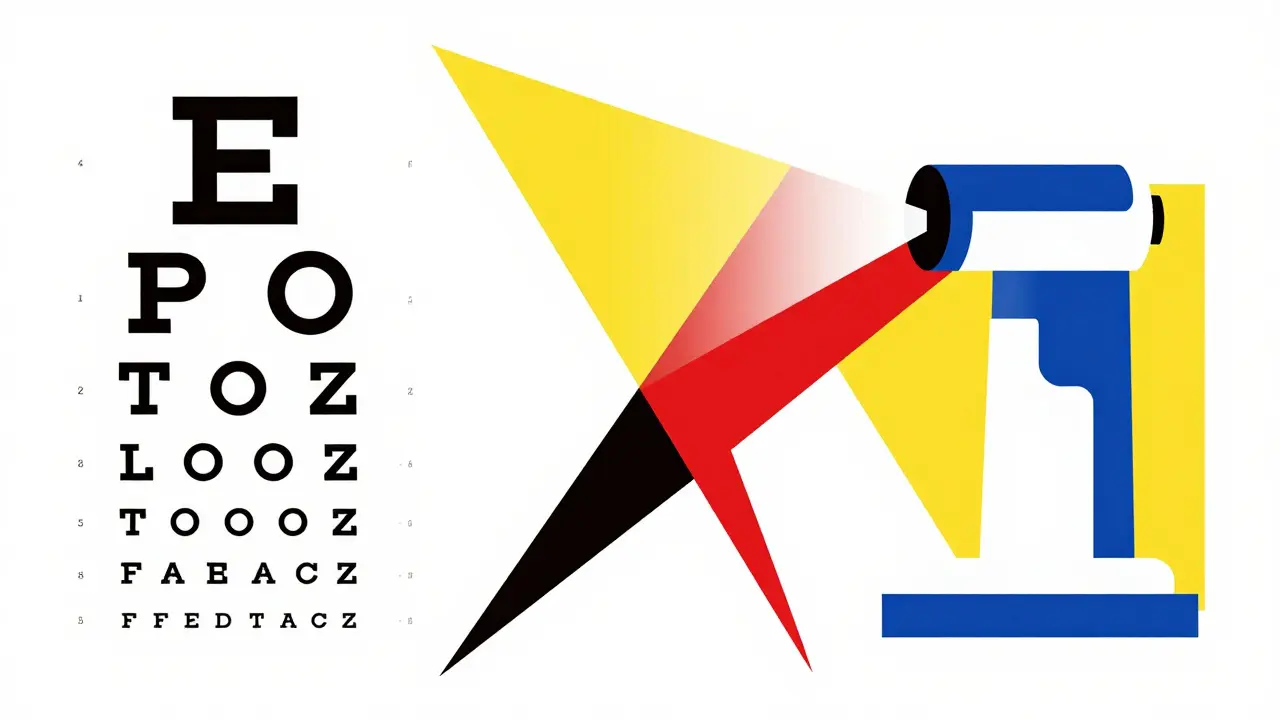
You might expect one test for all ages, but effective screening requires a tailored approach. As a child grows, their cognitive ability changes, and so does the tool used to assess their eyes. For infants from birth to 6 months, the primary method is the red reflex test. This involves a healthcare provider shining a light into the eye from two to three feet away using a direct ophthalmoscope. A healthy eye reflects red; a white or absent reflex indicates potential issues like cataracts or retinoblastoma.
- Infants (0-6 months): Red reflex testing and inspection of external eye structure.
- Toddlers (6 months - 2.5 years): Observation of eye alignment and movement (motility assessment).
- Preschoolers (3-5 years): Introduction of visual acuity charts or instrument-based screening.
- School Age (6+ years): Traditional optotype charts (Sloan letters) become the gold standard.
The transition around age 2.5 to 3 years is crucial. Before this age, children typically cannot cooperate with letter charts. Instead, providers rely on observation and instruments. Around age 3, children can usually identify symbols on a chart. At this stage, passing criteria become precise. For example, at age 3, a child must identify most symbols on the 20/50 line. By age 5, they must handle the 20/32 line. These specific thresholds prevent false negatives where a child is told they are fine but actually need correction.
Comparing Screening Methods: Charts vs. Technology
There is a long-standing debate in pediatric optometry regarding the best way to screen. Broadly, the world divides into two camps: those who prefer traditional eye charts (optotypes) and those who favor modern handheld devices (instrument-based screening). Both have merit, but they serve different needs in a clinical setting.
| Feature | Optotype-Based (Charts) | Instrument-Based (Screeners) |
|---|---|---|
| Typical Tool | Sloan Letters, LEA Symbols, HOTV | Autorefractor (e.g., SureSight, Plusoptix) |
| Time Per Child | 3 to 5 minutes | 1 to 2 minutes |
| Sensitivity | Varies (High for cooperative kids) | 71% to 89% (for amblyopia/strabismus) |
| Main Limitation | Requires active cooperation/cognition | Can produce false positives |
Optotype-based screening remains the "gold standard" for older children who can reliably interact with the tester. The Sloan Letters chart is preferred for ages 6 and up because it offers standardized data comparable across different clinics. However, for younger toddlers, cognitive limitations often fail the test not due to poor vision, but because they don't understand the game. This results in a failure rate of up to 25% for 3-year-olds who simply freeze up.
Enter instrument-based screening devices. Tools like the Retinomax or Power Refractor measure refractive error quickly without needing the child to read letters. The VIP study found these machines had a higher positive predictive value (68%) compared to conventional methods (52%) for children aged 3-4. They are fast-taking about two minutes-and bypass the frustration of trying to read tiny pictures. The blinq™ scanner, cleared by the FDA in 2018, is an example of next-generation tech that uses AI to achieve 91% specificity. While excellent, these machines sometimes flag minor errors that wouldn't require treatment, potentially sending families on a stressful journey to a specialist that wasn't needed.
Understanding the Referral Pathway
Parents often panic when a screening says "refer." It is important to remember that a screening is a gatekeeper, not a diagnosis. A positive result means the child meets the criteria for a professional examination, not that they definitely have a disease. The referral pathway connects the primary care doctor or school nurse with a pediatric ophthalmologist or optometrist.
This step is critical because treatment depends on the root cause. If the issue is a refractive error, glasses might solve it immediately. If it is amblyopia, the treatment usually involves forcing the brain to use the weaker eye through patching or atropine drops. Dr. Alex R. Kemker noted in recent literature that instrument-based screening is becoming the standard of care specifically because it reduces the barrier to entry, allowing more kids to get caught early. However, Dr. Graham Quinn cautions that no single test is perfect, suggesting a combination approach for tricky cases in the 3-4 year range to maximize accuracy.
Economically, this pathway pays off for everyone. A cost-benefit analysis by the USPSTF estimated a return of $3.70 for every dollar spent on screening programs. This calculation includes avoiding the lifetime costs of low vision, which can amount to billions annually in lost productivity and social services. For the family, the savings are in quality of life, educational performance, and confidence.
Barriers to Implementation and Access
Even with robust guidelines, gaps remain. About 76 million children under 18 receive pediatric care in the U.S. alone, yet access varies wildly. Socioeconomic status plays a massive role; some states mandate school-entry screening, but enforcement is spotty. Disparities are documented, with Hispanic and Black children being 20-30% less likely to receive recommended screening compared to peers.
Training is another hurdle. A provider needs roughly 2 to 4 hours of training to feel proficient, yet many general practitioners haven't received hands-on instruction since medical school. Common mistakes include improper chart illumination, incorrect distance measurement, or skipping the monocular check. Imagine measuring visual acuity from 9 feet instead of 10-the math shifts enough to change a diagnosis. Quality assurance checks should happen quarterly to keep skills sharp.
Looking forward, we anticipate further integration of AI and mobile screening to lower these barriers. Research published in JAMA Pediatrics suggests feasibility for screening as young as 9 months using portable tools. As technology evolves, the hope is to democratize access, ensuring a toddler in a rural area gets the same screening accuracy as one in a major city.
When should my child have their first vision screening?
According to the Bright Futures Periodicity Schedule, screenings should occur at regular intervals. Ideally, a red reflex exam happens at birth, followed by instrument-based or behavioral screening at 1 year. Formal visual acuity testing begins around age 3 to 4, with the USPSTF strongly recommending a definitive screening between 3 and 5 years old.
What is the difference between a screening and an exam?
A screening is a quick pass/fail check to identify risk factors, performed by trained nurses or pediatricians. An exam is a comprehensive diagnostic evaluation by an eye doctor (ophthalmologist or optometrist) that confirms the diagnosis and prescribes treatment. You always follow up a failed screening with an exam.
Can children with autism be screened effectively?
Standard optotype charts can be difficult for children with developmental delays. Instrument-based screening is often recommended for this population because it requires less verbal interaction. However, cooperation is still necessary, and repeat visits may be required to get accurate readings.
Is insurance coverage available for these tests?
Yes, under the Affordable Care Act in the U.S., Essential Health Benefits include pediatric vision services. Most state Medicaid programs cover screening as part of well-child visits. Private insurance plans vary, so checking your policy details for "vision benefits" versus "medical benefits" is wise.
What happens if a child misses their window for plasticity?
Treatment becomes significantly harder after age 7-8. While some improvement is possible later, the likelihood of restoring normal vision drops sharply. Late detection often means managing symptoms rather than curing the underlying amblyopia, impacting reading ability and depth perception for life.


Write a comment