


Imagine spending years in medical school learning the intricate molecular pathways of a drug, only to realize you have no idea how to explain why a generic version of that drug is the same as the brand-name one. For many physicians, this is the reality. Despite the fact that generic drug equivalence is the backbone of modern affordable healthcare, there is a startling gap between regulatory science and what doctors actually know. While the FDA and EMA have strict rules, the classroom often forgets to mention them.
To understand the problem, we first need to define Bioequivalence. In simple terms, it is the absence of a significant difference in the rate and extent to which the active ingredient of a generic drug becomes available at the site of action compared to the brand-name drug. To get a generic approved, companies must prove that the drug's AUC (area under the curve) and Cmax (maximum concentration) fall within a tight 80-125% range of the original product. This isn't a guess; it's a rigorous mathematical standard involving pharmacokinetic studies in healthy volunteers.
The Knowledge Gap in Medical School
Why do so many doctors struggle with this? The issue often starts in the lecture hall. A 2024 report in JAMA Internal Medicine highlighted a common frustration: pharmacology courses might spend twelve hours on how a brand-name drug works but less than thirty minutes on the principles of generic substitution. When 78% of medical case studies use brand names, students naturally develop a "brand-name habit." They learn the trade name, not the International Nonproprietary Name or INN, which is the global standardized name for the active pharmaceutical ingredient.
This lack of formal training leads to a strange paradox. A Malaysian study published via the NCBI found that 100% of participating doctors had inadequate knowledge and held misconceptions about generics before they received a targeted educational intervention. It turns out that knowing a drug's mechanism doesn't automatically mean you understand the regulatory framework that makes a generic safe to use.
When Theory Hits the Clinic
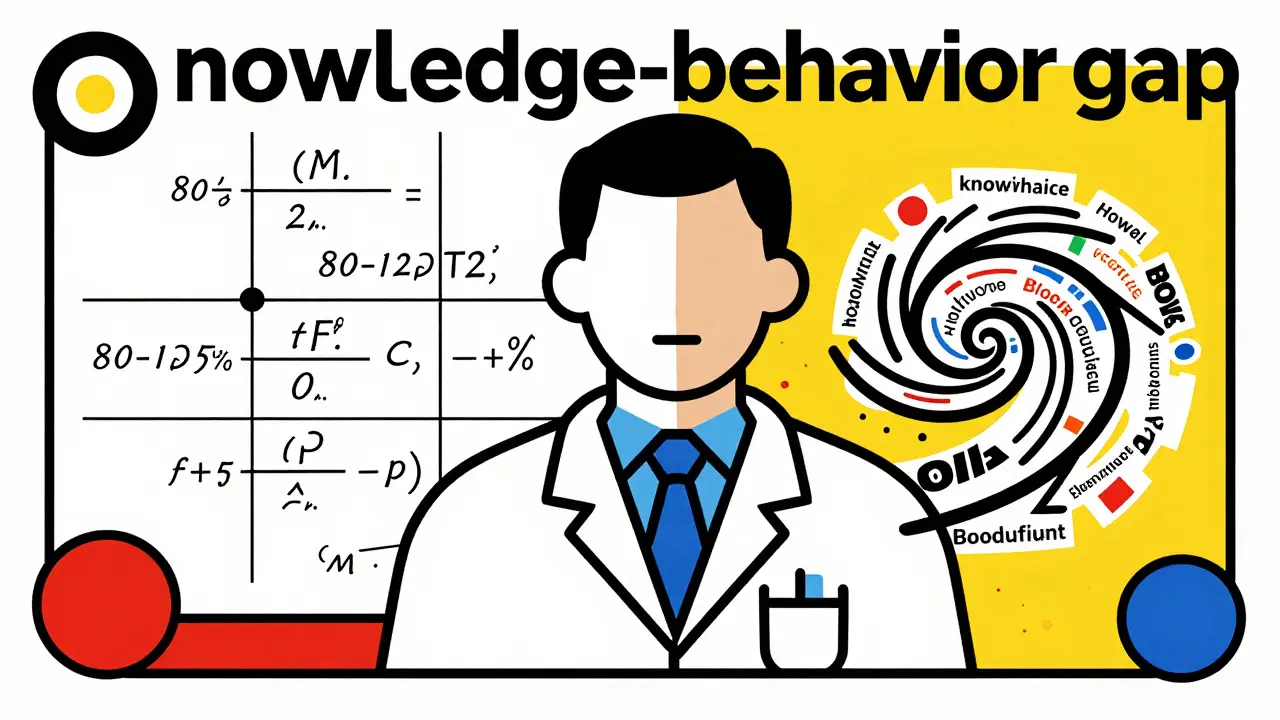
Even when doctors are taught the science, their behavior doesn't always change. This is the "knowledge-behavior gap." In the same Malaysian study, a 45-minute interactive lecture improved test scores by over 25%, but it didn't actually change how doctors wrote their prescriptions. Why? Because workplace culture is stronger than a one-off lecture. Junior doctors often mirror the prescribing habits of their seniors, who might prefer trade names out of habit or a misplaced sense of caution.
Then there are the real-world "horror stories" that haunt prescribing habits. Take the 2016 Concerta situation, where some physicians reported a lack of therapeutic effect with certain generic methylphenidate products. Even though the drugs met bioequivalence standards, these anecdotal experiences create a lasting bias. On the physician-only network Sermo, nearly 68% of surveyed doctors reported occasional concerns about generic performance, particularly with Narrow Therapeutic Index drugs, where a small change in dose or blood concentration can lead to a significant change in the drug's effect, such as warfarin or levothyroxine.
| Specialty | Generic Prescribing Rate | Primary Driver of Hesitation |
|---|---|---|
| Primary Care | 82% | General cost concerns |
| Psychiatry | 47% | Perceived efficacy variations |
| Neurology | 39% | Stability in epilepsy (NTI drugs) |
Bridging the Gap: What Actually Works?
If passive guidelines and short lectures aren't working, what will? Evidence suggests that longitudinal, active learning is the only way forward. Research in Nature Scientific Reports indicates that pharmacist training requires reviewing about 2,000 prescriptions to reach competency. Physicians likely need a similar experiential approach. One highly effective tool is the "teach-back" method, where the provider asks the patient to explain the concept of generic equivalence back to them. This doesn't just educate the patient; it forces the doctor to simplify and solidify their own understanding.
Some institutions are already taking drastic steps. The Karolinska Institute began requiring mandatory INN prescribing in medical school evaluations in 2018, which led to a 47% increase in INN use among its graduates. When you change the grading criteria, you change the behavior.
The Economic and Human Cost of Ignorance
This isn't just an academic debate. The financial stakes are massive. In the U.S., generics make up about 90% of all prescriptions dispensed, yet they only account for 22% of the total spending. If physicians were more confident in their knowledge of equivalence, the U.S. healthcare system could potentially save $156 billion annually by 2030.
More importantly, it affects patient trust. When a doctor seems unsure about a generic substitution, the patient picks up on it. A 2024 Kaiser Family Foundation poll showed that 38% of U.S. adults are worried about generic quality. Much of this skepticism stems from inadequate communication at the point of care. If the person in the white coat isn't confident, why would the patient be?
Future Directions in Provider Education
The tide is slowly turning. The FDA recently launched microlearning modules-15-minute bursts of information designed for busy clinicians who only have seconds to make a decision. There is also a push to integrate bioequivalence data directly into electronic health records (EHRs). Instead of a doctor having to remember the 80-125% rule, the system can flag a generic substitution and provide a quick link to the bioequivalence data for that specific drug.
As we move toward "complex generics"-like specialized inhalers or topical products-the education needs to become even more nuanced. These products don't just require a simple blood-level check; they require sophisticated demonstrations of equivalence that will challenge the next generation of medical curricula.
Does bioequivalence guarantee a generic drug works exactly like the brand?
Yes, in terms of the active ingredient. Bioequivalence means the rate and extent of absorption are virtually the same. However, generics may use different inactive ingredients (excipients), which in rare cases can cause different side effects or absorption issues in highly sensitive patients.
Why are neurologists more hesitant to prescribe generics?
Neurologists often treat patients with epilepsy using Narrow Therapeutic Index (NTI) drugs. In these cases, even a tiny fluctuation in blood concentration can trigger a seizure, leading some specialists to prefer the perceived consistency of a single brand-name manufacturer.
What is INN prescribing and why does it matter?
INN stands for International Nonproprietary Name. Prescribing by INN means writing the generic name of the drug (e.g., Paracetamol) rather than the brand name (e.g., Tylenol). This removes brand bias and allows pharmacists to provide the most cost-effective equivalent available.
How long does it take for a doctor to truly master bioequivalence concepts?
Based on recent studies, it typically requires 10-15 hours of dedicated instruction combined with 50-100 real-world prescribing decisions with active feedback to move from basic knowledge to clinical confidence.
Can a 45-minute lecture fix the generic knowledge gap?
It can improve theoretical knowledge scores-sometimes by over 25%-but it rarely changes actual prescribing behavior. Long-term behavior change requires integrated clinical practice and systemic incentives, like those seen at the Karolinska Institute.