



Acromegaly isn’t just about big hands or a protruding jaw. It’s a serious, slow-moving hormonal disorder that quietly changes your body over years - often before you even realize something’s wrong. If you’ve noticed your rings don’t fit anymore, your voice has gotten deeper, or your jaw seems to have grown out of nowhere, it might not be aging. It could be acromegaly.
What Exactly Is Acromegaly?
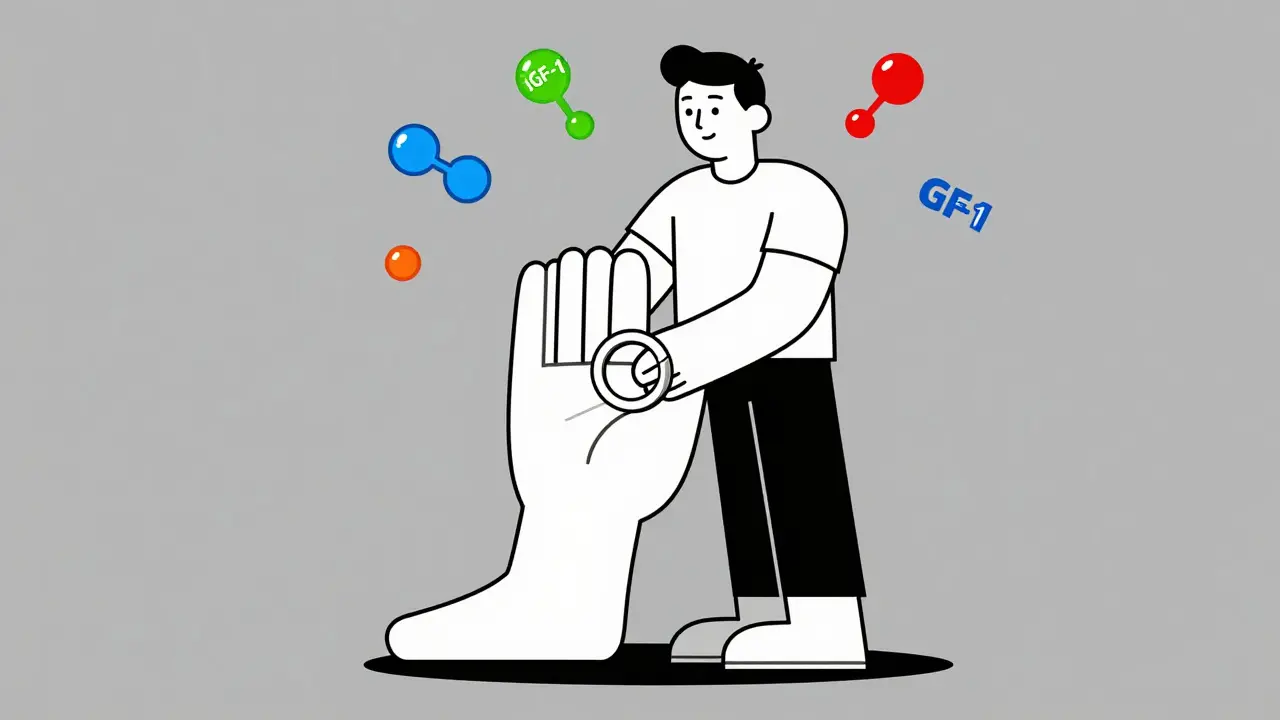
Acromegaly happens when your body makes too much growth hormone (GH) - usually because of a small, noncancerous tumor in the pituitary gland. This tumor doesn’t spread, but it does overproduce GH, which then floods your bloodstream. That extra hormone tells your liver to pump out even more insulin-like growth factor-1 (IGF-1), and that’s what actually causes the damage.
Unlike gigantism - which happens in kids before their growth plates close - acromegaly affects adults. Once your bones stop growing, they can’t get longer. But they can get thicker. Your hands, feet, jaw, and even internal organs start to enlarge. That’s why most people don’t notice until they look at an old photo and realize their face looks completely different.
It’s rare. About 3 to 4 new cases happen every million people each year. Most people are diagnosed between 30 and 50. But here’s the kicker: it often takes 7 to 10 years to get diagnosed. Why? Because the changes are gradual. You don’t wake up one day with a giant jaw. You slowly start needing bigger shoes, your jaw aches, your skin gets oily, and your doctor dismisses it as "just getting older."
The Physical Signs You Can’t Ignore
There’s a pattern to how acromegaly shows up. In 90% of cases, your hands and feet get noticeably bigger. You might need new shoes or your wedding ring won’t slide off anymore. Your facial bones change - the brow ridge sticks out, your jaw juts forward, your nose and lips thicken. You might start snoring louder or develop sleep apnea. That’s because your tongue and throat tissues grow too.
Almost 70% of people with acromegaly have oily skin and enlarged pores. Some develop skin tags. Your voice drops because your vocal cords thicken. About 47% get carpal tunnel syndrome from swollen tissues pressing on nerves in the wrist. Joint pain is common - nearly 8 out of 10 people deal with it. And spinal deformities? They happen too.
Headaches? Common. Vision problems? Yes - if the tumor presses on the optic nerve, you might lose peripheral vision. About 44% of patients have this. And it’s not just your body changing. Your metabolism goes haywire. About one in three people develop type 2 diabetes. High blood pressure affects up to half. And your heart? It thickens. Left ventricular hypertrophy is present in 60% of untreated cases. That’s why untreated acromegaly can cut your life short by 10 to 15 years.

How Is It Diagnosed?
Diagnosis starts with two blood tests. First, IGF-1. This level stays steady throughout the day, unlike GH, which spikes and crashes. So IGF-1 is your best clue. But it has to be checked against your age - a high IGF-1 for a 25-year-old might be normal for a 50-year-old.
The second test is the oral glucose tolerance test. Normally, drinking a sugary solution should shut off GH production. In acromegaly? It doesn’t. If your GH level stays above 1 μg/L after the sugar drink, it’s a strong sign of the disease.
Then comes the MRI. About 90% of the time, you’ll see a pituitary tumor. Tumors are split into two types: microadenomas (smaller than 1 cm) and macroadenomas (1 cm or larger). Macroadenomas are more common - 75% of cases - and they’re more likely to cause vision problems or crush other parts of the pituitary gland.
It’s not just about the numbers. Doctors look at your face, your hands, your joint movement, your sleep habits. Sometimes, AI tools are being tested to detect subtle facial changes in old photos - a 2023 study showed 89% accuracy using this method. It’s not standard yet, but it might change how fast we catch this.
Treatment: Surgery, Medication, Radiation
The goal isn’t just to shrink the tumor. It’s to get your GH and IGF-1 levels back to normal. Studies show that once you do that, your risk of early death drops to nearly the same as someone without the disease.
Surgery is the first choice for most people. The procedure - called transsphenoidal surgery - means the surgeon goes through the nose or upper lip to reach the pituitary. No big incisions. If the tumor is small (microadenoma), success rates are 80-90%. For larger tumors, it’s 40-60%. Recovery takes 2-4 weeks. But even if the tumor is removed, you might still need medication if hormone levels don’t normalize.
Medication comes next if surgery doesn’t work or isn’t an option. There are three main types:
- Somatostatin analogs - like octreotide (LAR) or lanreotide. These block GH release. Monthly injections. Cost: $6,200-$7,800 per month in the U.S. Some people get side effects like gallstones or digestive issues.
- Dopamine agonists - like cabergoline. Less effective than somatostatin analogs, but cheaper. About $150-$300 a month. Works best if the tumor makes prolactin too.
- Growth hormone receptor antagonist - pegvisomant. This doesn’t lower GH. It blocks it from working. So GH levels might stay high, but IGF-1 drops. Cost: $12,000-$15,000 a month. Used when other drugs fail.
Some new options are coming. In July 2023, the FDA approved a new long-acting pasireotide that only needs quarterly shots. That’s a big deal for people tired of monthly injections.
Radiation is usually a last resort. It can take 5-10 years to work. And it carries a 30-50% risk of destroying other parts of the pituitary gland. That means you’ll need lifelong hormone replacements - for cortisol, thyroid, sex hormones, even water balance. It’s not ideal, but for some, it’s the only option left.

The Hidden Costs: Life After Treatment
Even when treatment works, life doesn’t go back to normal overnight. Many people still have joint pain for years. One Reddit user shared that it took three years after surgery for his joint pain to fade. Fatigue? Still common - 58% of patients report it even after GH levels are normal.
And then there’s the money. Insurance often fights to cover somatostatin analogs or pegvisomant. In the U.S., 32% of patients wait over 30 days just to get approval. In Australia, Medicare covers some, but out-of-pocket costs can still hit thousands a year.
One of the biggest risks after treatment? Hypopituitarism. About 28% of patients end up with low levels of other hormones - cortisol, thyroid, testosterone, estrogen. That means you’ll need regular blood tests and possibly daily pills for the rest of your life. Miss a dose? You could go into adrenal crisis - a life-threatening emergency.
What You Need to Do Now
If you suspect acromegaly - whether because of changes in your face, hands, or health - don’t wait. Go to your doctor. Ask for an IGF-1 test. If it’s high, push for an MRI. If your doctor brushes you off, find an endocrinologist. Specialized pituitary centers have much better outcomes. One study found 74% of patients treated at high-volume centers were satisfied - compared to 49% at low-volume ones.
Keep track of your symptoms. Measure your ring size. Take photos of your face every year. Note when you start snoring, when your joints hurt, or when your energy drops. These aren’t just "annoyances." They’re clues.
And if you’ve been diagnosed - stay on top of your care. Regular IGF-1 checks every 3-6 months. Watch for signs of low hormones. Talk to your endocrinologist, neurosurgeon, and GP. This isn’t a one-time fix. It’s lifelong management.
The good news? With treatment, life expectancy can return to normal. The bad news? It takes time, money, and persistence. But you’re not alone. Thousands of people live with this. And with the right care, you can still live well.
Can acromegaly be cured?
Acromegaly can be controlled - and in many cases, effectively cured - if the pituitary tumor is fully removed and hormone levels return to normal. Surgery offers the best chance for cure, especially with small tumors. For others, long-term medication can keep GH and IGF-1 levels stable. But "cured" doesn’t always mean "back to normal." Some physical changes, like joint damage or heart thickening, may not reverse. Lifelong monitoring is still needed.
Is acromegaly hereditary?
In over 95% of cases, acromegaly is not inherited. It’s caused by a spontaneous mutation in a pituitary cell that leads to a tumor. But in about 5% of cases, it’s linked to rare genetic syndromes like multiple endocrine neoplasia type 1 (MEN1) or familial isolated pituitary adenoma (FIPA). If you have a close relative with acromegaly or pituitary tumors, genetic testing may be recommended.
Why does it take so long to diagnose?
The symptoms develop slowly over years - enlarged hands, deeper voice, joint pain - and are often mistaken for aging, arthritis, or obesity. Many patients see 7-11 doctors before getting the right diagnosis. A 2023 study found 68% of patients waited 7+ years. Lack of awareness among general practitioners and the rarity of the condition contribute to the delay. Specialized pituitary centers are much faster at diagnosing it.
Can lifestyle changes help manage acromegaly?
Lifestyle changes won’t fix the hormone imbalance, but they can help manage complications. Losing weight reduces pressure on joints and improves diabetes control. Regular exercise supports heart health. Avoiding alcohol and sleeping on your side helps with sleep apnea. Quitting smoking lowers cardiovascular risk. But these are supportive - not replacements - for medical treatment.
What happens if I stop my medication?
Stopping medication without medical supervision can cause GH and IGF-1 levels to spike again. This means symptoms return - and fast. Joint pain, fatigue, high blood pressure, and diabetes can worsen. Worse, your risk of heart failure, stroke, or early death goes up. Never stop your meds without talking to your endocrinologist. Even if you feel fine, your hormone levels may still be off.


Write a comment