

When a pharmaceutical company wants to sell a generic version of a popular drug, they don’t have to repeat every clinical trial the original brand did. Instead, they prove something simpler but just as critical: bioequivalence. This means the generic drug delivers the same amount of active ingredient into the bloodstream at the same speed as the brand-name version. If it passes, doctors can prescribe it with full confidence. But how exactly is this proven? It’s not guesswork. It’s a tightly controlled, science-driven process - and here’s how it actually works.
Why Bioequivalence Matters
Imagine you’re prescribed a drug like simvastatin for cholesterol. The brand-name version costs $150 a month. The generic? $12. That’s not magic - it’s bioequivalence. The U.S. Food and Drug Administration (FDA) has approved over 900 generic drugs each year based on this single proof. Since 2010, generics have saved the U.S. healthcare system more than $1.6 trillion. But none of that savings would matter if the generic didn’t work the same way. That’s why regulators demand proof - not promises.
It’s not just about cost. It’s about consistency. If a patient switches from brand to generic and their blood pressure spikes or their seizures return, that’s a failure. Bioequivalence studies are the safety net. They ensure that even though the pill looks different, the body treats it the same.
The Core Design: Crossover Study
The most common way to test bioequivalence is a two-period, two-sequence crossover design. Sounds complicated? Here’s what it really means.
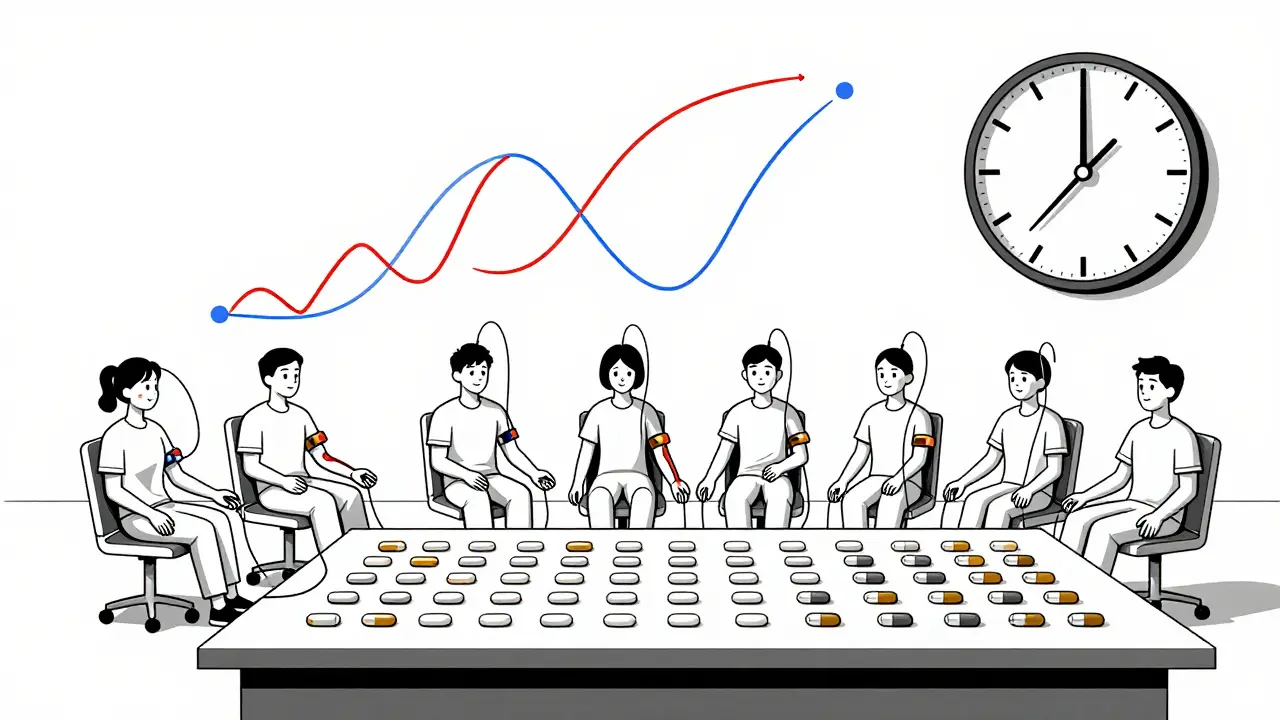
You recruit 24 to 32 healthy adults - no one with major illnesses, no smokers, no one on other medications. They come in for two separate visits, weeks apart. In the first period, half the group gets the brand-name drug (the reference product). The other half gets the generic (the test product). After a washout period - usually five times the drug’s elimination half-life - they switch. So everyone ends up taking both.
This design cuts out noise. If one person naturally metabolizes drugs faster, they’re still their own control. You’re not comparing different people. You’re comparing how the same person’s body responds to two versions of the same drug.
What Gets Measured: Cmax and AUC
After each dose, researchers draw blood. Not just once. They take samples every 15 to 30 minutes at first, then every hour or two, for up to 72 hours. Why? To map the drug’s journey through the body.
Two numbers matter most:
- Cmax - the highest concentration of the drug in the blood. This tells you how fast the drug gets absorbed.
- AUC(0-t) - the area under the concentration-time curve from time zero to the last measurable point. This tells you how much of the drug was absorbed overall.
A third, less commonly used metric is AUC(0-∞), which estimates total absorption even after the last sample. But AUC(0-t) is the standard.
These aren’t just numbers. They’re the foundation of the entire approval. If the generic’s Cmax and AUC are too far off from the brand’s, it fails.
How They Analyze the Data
Raw blood concentrations don’t tell the whole story. Because drug levels vary widely between people, researchers log-transform the data. Then they run a statistical model - usually a two-way ANOVA - with factors for sequence, period, treatment, and subject.
The goal? Calculate the 90% confidence interval for the ratio of test to reference.
Here’s the rule: For most drugs, the 90% CI for both Cmax and AUC must fall between 80% and 125%. That means the generic’s average exposure can’t be more than 25% higher or 20% lower than the brand.
For drugs with a narrow therapeutic index - like warfarin, lithium, or levothyroxine - the window tightens to 90% to 111%. One percent too far out, and the application gets rejected.
What Happens If the Drug Is Highly Variable?
Some drugs - like cyclosporine or clopidogrel - vary wildly from person to person. A 20% difference in Cmax might be normal. The old 80-125% rule doesn’t work here.
That’s where replicate designs come in. Instead of two periods, subjects get four: test, reference, test, reference (or reference, test, reference, test). This lets researchers estimate how much variation comes from the drug itself versus the person.
The FDA allows a method called reference-scaled average bioequivalence (RSABE). If the brand’s own variability is high, the acceptance range expands - but only if the generic matches the brand’s variability pattern. The European Medicines Agency (EMA) prefers this too, but requires a minimum of 50 subjects.
Without this flexibility, many important drugs would never have generics. These methods are what make modern generic access possible.
What About Other Methods?
Not all drugs can be tracked through blood. For example:
- Topical creams (like corticosteroids) don’t enter the bloodstream much. Regulators look at skin absorption and clinical response.
- Inhalers (like asthma drugs) require lung deposition tests - not blood levels.
- Anticoagulants (like warfarin) might use a pharmacodynamic endpoint: how long it takes for blood to clot.
But for oral, systemic drugs - the vast majority - pharmacokinetics (blood levels) is the gold standard. Over 95% of bioequivalence submissions rely on it.
The Test Product Must Be Real
A common mistake? Testing a small lab batch. That won’t cut it.
The generic must come from a batch made at commercial scale - at least 10% of the planned production size or 100,000 units, whichever is larger. Why? Because manufacturing changes can alter how the drug dissolves or absorbs. A tablet made in a 100-unit pilot run behaves differently than one made on a 10-million-unit line.
Regulators also require that the reference product be from a single batch of the original brand. Not a mix. Not a new lot. One batch. That’s the benchmark.
Dissolution Testing: The Silent Partner
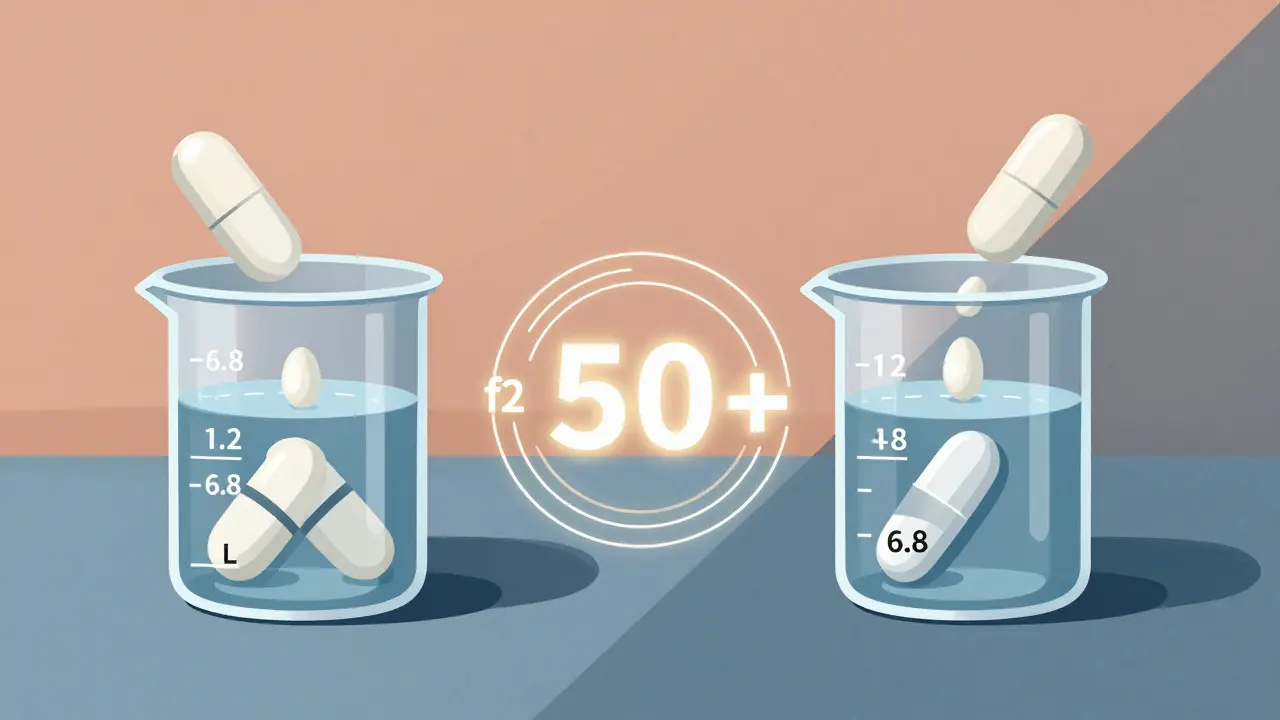
Before any human study, the drug is tested in a beaker. Literally. Dissolution testing simulates how the pill breaks down in stomach acid (pH 1.2) and intestine (pH 6.8). At least 12 units are tested at multiple time points.
The profiles of the generic and brand must match - with an f2 similarity factor above 50. If they don’t, the study is likely to fail, even if blood levels look good. Why? Because if the pill doesn’t dissolve the same way, future manufacturing changes could break bioequivalence.
For certain drugs - especially BCS Class I (highly soluble, highly permeable) - regulators may waive the human study entirely. But this is rare. Only about 27% of approvals in 2022 used this shortcut.
Pilot Studies: The Hidden Key to Success
Most failed bioequivalence studies aren’t because the drug doesn’t work. They fail because of poor planning.
According to FDA data, 45% of deficient studies had inadequate washout periods. 30% had sampling schedules that missed peak concentrations. 25% had flawed statistics.
That’s why smart companies run a pilot study - with 8 to 12 subjects - before the full trial. It’s not optional. It’s insurance. A 2022 survey of contract research organizations (CROs) found that 89% of successful studies used pilot data to tweak their design. One CRO told me: "We lost a $250k study because we thought a 72-hour half-life drug needed a 7-day washout. We were wrong. It needed 10 days. The subjects were still dosed when we started the second period. Total disaster."
Common Pitfalls and Real-World Failures
It’s not just about the science. It’s about execution.
- Assay failures: If the lab can’t accurately measure the drug in blood, the whole study is invalid. BioAgilytix reported 22% of studies face delays due to analytical method issues.
- Subject dropout: In long studies (over 10 days), 5-15% of volunteers quit. That can throw off statistical power.
- Wrong reference product: Using an expired brand batch or one from a different country? Rejection.
- Statistical missteps: Using the wrong confidence interval or forgetting to log-transform data? Automatic rejection.
Alembic Pharmaceuticals’ 2022 rejection of a generic version of Trulicity (dulaglutide) was due to inconsistent Cmax values across three studies. The drug’s formulation was too sensitive to minor changes. The company had to go back, reformulate, and restart.
What Happens After the Study?
Once the data is clean, the company submits a full dossier to the regulator - FDA, EMA, PMDA, or Health Canada. The package includes:
- The full protocol
- Statistical analysis plan
- Validation reports for the lab methods
- Dissolution profiles
- Subject demographics and compliance logs
The FDA receives about 2,500 bioequivalence submissions each year. The median review time? 10.2 months. If the data is solid, approval comes. If not, they issue a complete response letter - and the company has to fix it.
And then? The generic hits the market. Millions of patients get cheaper, equally effective medicine. All because a few dozen healthy volunteers gave blood, sat in a clinic, and followed strict rules.
The Future: Modeling, Simulation, and Beyond
Regulators are starting to use computer models. Physiologically based pharmacokinetic (PBPK) models simulate how a drug behaves in the body based on its chemistry and physiology. The FDA saw a 35% increase in PBPK applications between 2020 and 2023.
For complex products - like inhalers or long-acting injectables - these models may eventually replace human studies. But for now, blood samples are still king.
The goal isn’t to eliminate human studies. It’s to make them smarter. Pilot data. Real-time analysis. Better models. All to reduce failure rates and get safe generics to patients faster.
What is the main purpose of a bioequivalence study?
The main purpose is to prove that a generic drug delivers the same amount of active ingredient into the bloodstream at the same rate as the brand-name drug. This ensures the generic works the same way in the body, making it a safe and effective substitute.
Why are healthy volunteers used instead of patients?
Healthy volunteers eliminate confounding variables like disease, other medications, or organ dysfunction. This lets researchers focus purely on how the drug is absorbed and processed. Once bioequivalence is proven, the drug can be safely used in patients.
How long does a typical bioequivalence study take?
A standard two-period crossover study takes 6 to 10 weeks total. Each dosing period lasts 1 to 3 days, with a washout period of 1 to 3 weeks in between. Studies for drugs with long half-lives (like some antidepressants) can take 3 to 6 months.
What happens if a bioequivalence study fails?
If the 90% confidence interval for Cmax or AUC falls outside 80-125%, the study fails. The company must either reformulate the drug, run a new study with a different design, or switch to a different regulatory pathway (like clinical endpoint studies). Many companies run pilot studies to avoid this.
Are bioequivalence studies the same worldwide?
The core principles are similar - 80-125% CI for Cmax and AUC - but details vary. The FDA allows reference-scaled methods for highly variable drugs. The EMA requires replicate designs with more subjects. Japan demands additional dissolution testing. But all major agencies agree on the goal: therapeutic equivalence.


Write a comment