

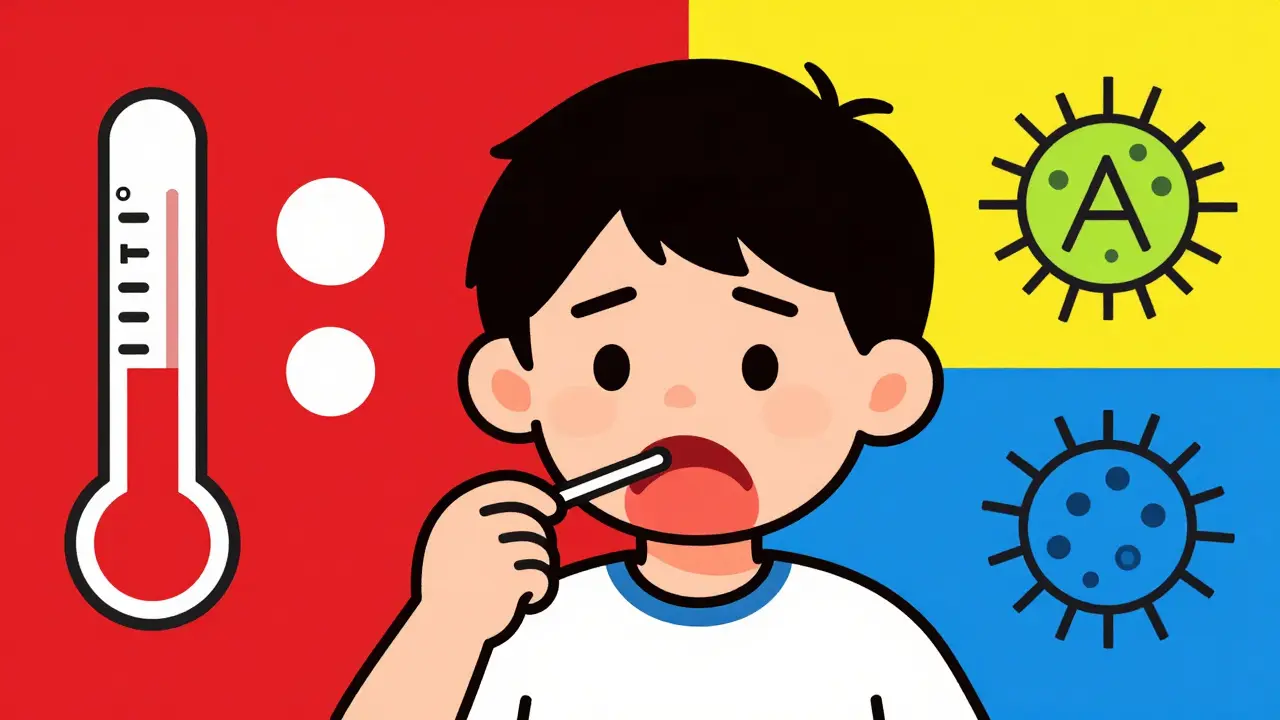
When your throat feels like it’s on fire and swallowing feels impossible, it’s easy to assume it’s just a cold. But if the pain came on suddenly, you have a fever, and no cough or runny nose - it might be something more serious: strep throat. This isn’t just a bad sore throat. It’s a bacterial infection caused by Group A Streptococcus, and if left untreated, it can lead to complications like rheumatic fever, which can damage your heart. The good news? It’s treatable. But only if you know what to look for, when to get tested, and how to take your medicine the right way.
How to Tell If It’s Strep - Not Just a Cold
Not every sore throat is strep. In fact, most are viral - caused by the same bugs that give you the common cold or flu. But strep throat has a signature pattern. It hits fast. One day you’re fine, the next you can’t swallow without wincing. You might feel achy, tired, or even nauseous. Fever is common, usually above 100.4°F (38°C). Your tonsils may look red and swollen, sometimes with white patches or pus. The lymph nodes in your neck might be tender to the touch. Here’s the key: if you have a cough, runny nose, or red eyes, it’s probably not strep. Those are classic signs of a virus. Strep throat usually skips those symptoms. That’s why doctors use something called the Centor criteria to help decide if testing is needed. You get one point each for:- Absence of cough
- Fever over 100.4°F
- Tender swollen lymph nodes in the neck
- White patches or swelling on the tonsils
Testing: Rapid Test, Culture, or PCR?
There are three main ways to confirm strep throat. The most common is the rapid antigen detection test (RADT). A swab is taken from the back of your throat, and results come in 10 to 30 minutes. It’s fast, but not perfect. It catches about 85-95% of true strep cases. That means about 5-15% of the time, it gives a false negative - especially in younger kids who have less bacteria in their throat. That’s why, for children and teens, if the rapid test is negative but the doctor still suspects strep, they’ll send a throat culture. This is the gold standard. It takes 18 to 48 hours to get results, but it’s more accurate. It catches almost all cases that the rapid test misses. A newer option is molecular testing (PCR). It’s even more sensitive - catching 95-98% of infections - and results come in 24 to 48 hours. It’s becoming more common in urgent care centers and hospitals. The FDA approved a new test called Strep Ultra in March 2024 that gives results in just 15 minutes with near-perfect accuracy. It’s likely to replace older rapid tests in the next few years.Which Antibiotics Work Best?
If you have strep throat, antibiotics are necessary. They don’t just make you feel better faster - they stop you from spreading it and prevent serious complications. The first-line treatment is still penicillin V or amoxicillin. These are cheap, effective, and have been used for decades. For adults, penicillin V is usually 500 mg twice a day for 10 days. Amoxicillin is often given as a single daily dose (up to 1000 mg) because it’s easier to remember. For kids, dosing is based on weight. Amoxicillin is typically 50 mg per kg per day, split into two doses. A child weighing 30 kg (about 66 lbs) would get 750 mg total per day - 375 mg twice a day. If you’re allergic to penicillin, there are alternatives. Cephalexin (a cephalosporin) is often used. Clindamycin or azithromycin are options too, but they’re not as reliable. Azithromycin works in just 5 days, but it’s less effective - it clears the bacteria in about 85-90% of cases, compared to 95% with penicillin. Also, resistance to azithromycin is rising in some areas, hitting 15% in parts of the U.S. It’s not about which drug is “strongest.” It’s about using the right one for your body and the strain you have. Penicillin resistance is extremely rare - less than 0.5% of cases. That’s why it’s still the go-to.
Recovery Timeline: What to Expect
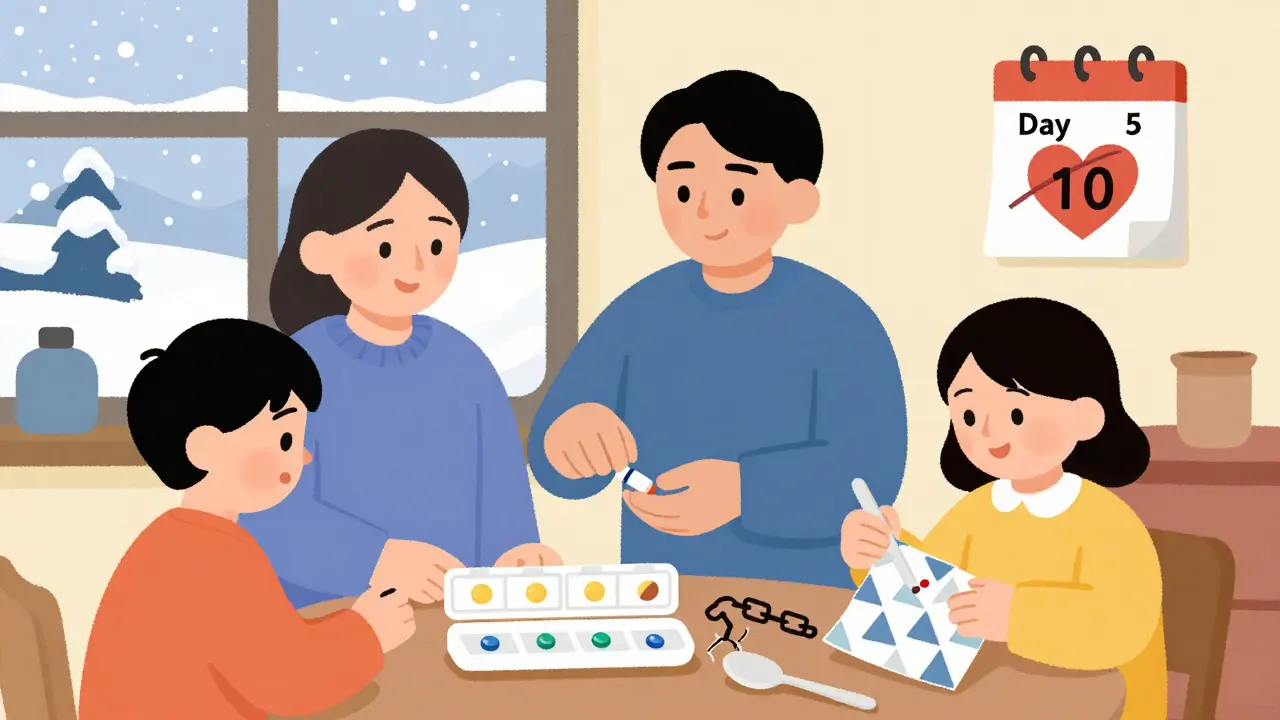
Once you start antibiotics, things change fast. Most people feel noticeably better within 24 to 48 hours. Fever drops. Swallowing gets easier. Energy returns. But feeling better doesn’t mean you’re done. You still have to finish the full 10-day course - even if you’re 100% fine on day 5. Why? Because stopping early is one of the biggest mistakes people make. Studies show that 40% of parents stop antibiotics early when their kids start feeling better. That increases the chance of the infection coming back - and raises the risk of complications like rheumatic fever or a peritonsillar abscess (a pus-filled pocket near the tonsils, which happens in 1-2% of untreated cases). You’re contagious until you’ve been on antibiotics for at least 24 hours. That means stay home from school or work during that time. Don’t kiss anyone. Don’t share cups or utensils. Wash your hands often. After 24 hours, you can return to normal activities - as long as you’re fever-free and feeling okay. Complete recovery usually takes 7 to 10 days. If your symptoms don’t improve after 48 hours of antibiotics, or if they get worse - new pain, swelling, difficulty breathing, or a rash - call your doctor. You might have a complication or a different infection.Common Mistakes and What to Avoid
People make predictable errors with strep throat - and they’re costly.- Sharing antibiotics. 8% of adults admit to giving leftover antibiotics to family members. That’s dangerous. Wrong dose. Wrong drug. Wrong infection. It fuels resistance.
- Using old prescriptions. 12% of people use leftover antibiotics from past illnesses. If it was for a sinus infection last year, it won’t work for strep now. And it might make future infections harder to treat.
- Skipping the test. If you’re an adult with a cough and runny nose, you probably don’t need a strep test. But if you’re a child with no cough and a high fever - don’t guess. Get tested.
- Not finishing the course. As mentioned, this is the #1 reason for relapse. 95% of people who finish their antibiotics fully clear the infection. Only 85% do if they stop early.
What’s Changing in 2025?
The way we treat strep throat is evolving. The CDC has allocated $15 million to track antibiotic resistance patterns. A major clinical trial (NCT05678901) is testing whether a 5-day course of antibiotics works just as well as 10 days. Early results suggest it might - especially for adults. If confirmed, guidelines could change by late 2025. Vaccines? Not anytime soon. The bacteria has over 200 different strains, each with a slightly different surface protein. Making a vaccine that covers them all is incredibly hard. Right now, the best tool is still good diagnosis and proper antibiotic use.When to Call a Doctor
You don’t need to rush to the ER for every sore throat. But call your doctor if:- Symptoms don’t improve after 48 hours of antibiotics
- You develop a rash, swollen lymph nodes, or difficulty breathing
- Your child is drooling, can’t swallow, or seems unusually lethargic
- You’ve had repeated strep infections in the past year
- You have a history of rheumatic fever or heart problems
Can strep throat go away on its own without antibiotics?
Yes, strep throat can resolve on its own in 7 to 10 days. But that doesn’t mean it should. Without antibiotics, you remain contagious for up to two weeks, and your risk of developing rheumatic fever - which can permanently damage heart valves - increases by about 3%. Antibiotics cut transmission risk by 80% within 24 hours and prevent complications. The goal isn’t just symptom relief - it’s preventing long-term harm.
Is strep throat more common in winter?
Yes. Strep throat peaks between November and April, with up to 30% more cases during these months. This is likely due to people spending more time indoors in close contact, especially in schools and households. Cold, dry air may also make the throat more vulnerable to infection. Cases drop sharply in summer, but they don’t disappear entirely - climate change is causing more off-season cases than before.
Why is penicillin still the first choice if it’s so old?
Because it still works - better than almost anything else. Resistance to penicillin in Group A Streptococcus is under 0.5%. It’s cheap, safe, and kills the bacteria effectively. Newer antibiotics aren’t necessarily better - they’re often more expensive and sometimes less effective. Penicillin is the benchmark because it’s reliable. When something works this well for this long, there’s no reason to replace it.
Can you get strep throat more than once?
Yes. Having strep once doesn’t give you lifelong immunity. There are over 200 strains of Group A Streptococcus, and immunity to one doesn’t protect you from others. People who get strep repeatedly - especially children - may need further evaluation. In rare cases, chronic carriers (people who harbor the bacteria without symptoms) can spread it to others. If you’ve had three or more infections in a year, talk to your doctor about testing for carriage or possible immune factors.
Do rapid tests work for adults the same as for kids?
Not always. Rapid tests are less sensitive in children under 5 because they have lower bacterial loads in their throats. That’s why negative results in kids are often followed up with a throat culture. In adults, if the rapid test is negative and you have low risk factors (like cough or runny nose), further testing is usually not needed. Adults are less likely to develop serious complications, so guidelines are more relaxed.
Are there natural remedies that can cure strep throat?
No. Saltwater gargles, honey, warm tea, or essential oils might soothe a sore throat, but they do not kill the bacteria causing strep. Only antibiotics can eliminate Group A Streptococcus. Relying on home remedies instead of antibiotics risks complications like rheumatic fever or kidney inflammation. Don’t use natural remedies as a substitute - use them to help manage symptoms while antibiotics do their job.
How long should I stay home from work or school?
Stay home for at least 24 hours after starting antibiotics - and only return if you’re fever-free without the help of fever-reducing medicine. This isn’t just about feeling better. It’s about stopping the spread. You’re still contagious until the antibiotics have had time to reduce the bacteria in your throat. Returning too soon puts others at risk, especially in classrooms or offices.
What’s the cost difference between antibiotics for strep throat?
The cost varies widely. Generic penicillin V costs about $4 for a full 10-day course. Amoxicillin is around $10-$15. Cephalexin runs $15-$25. Brand-name azithromycin can cost $250 or more without insurance. Many clinics offer discounted generics through pharmacy programs. Always ask if there’s a cheaper option - you don’t need to pay more for the same effect.


Write a comment