


When you have asthma, it’s not always clear why your symptoms flare up. You might be using your inhaler every day, but still wheezing or waking up at night. That’s because asthma isn’t just about tight airways-it’s often driven by invisible inflammation inside your lungs. That’s where FeNO testing comes in. It’s a simple, non-invasive way to measure exactly how much inflammation is present in your airways, giving doctors a clear, objective signal to guide your treatment.
What Is FeNO Testing?
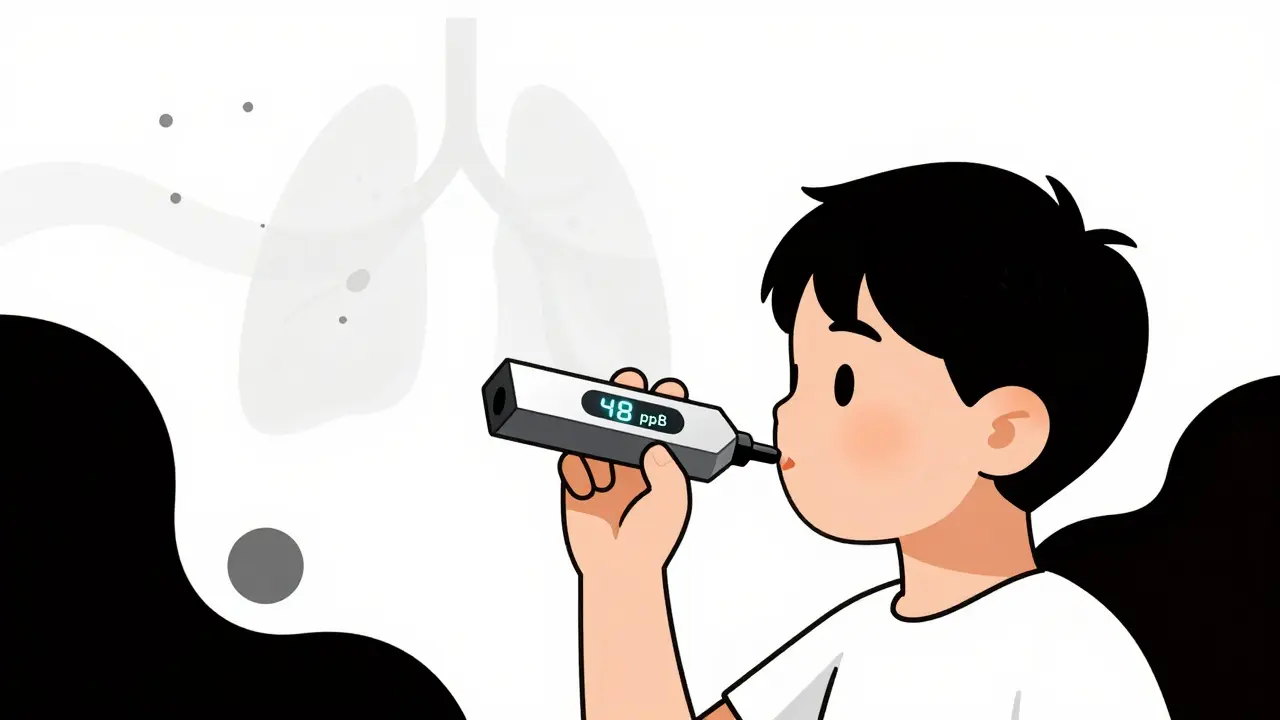
FeNO stands for Fractional Exhaled Nitric Oxide. It’s a breath test that measures the amount of nitric oxide in your exhaled air. Nitric oxide is a gas naturally produced by your body, and when your airways are inflamed-especially due to allergic or eosinophilic asthma-it makes more of it. The test tells you how much is there, in parts per billion (ppb). Higher levels mean more inflammation.
The test itself takes less than a minute. You breathe in deeply through a filter that removes outside air, then exhale slowly and steadily into a handheld device for about 10 seconds. It’s like blowing up a balloon, but much slower. No needles, no blood draws, no discomfort. Even children over five can do it without trouble. The device gives a reading right away, and your doctor knows what that number means for your asthma.
Why FeNO Levels Matter in Asthma
Not all asthma is the same. Some people have asthma triggered by allergies and have high levels of eosinophils-white blood cells that cause inflammation. Others have asthma caused by infections, pollution, or stress, with little to no eosinophil involvement. FeNO testing helps identify the first group. If your FeNO level is above 25 ppb (or 20 ppb for kids aged 5-12), it strongly suggests you have eosinophilic airway inflammation, which responds well to inhaled corticosteroids.
Studies show that people with high FeNO levels are up to seven times more likely to have asthma than those with normal levels, especially when lung function tests like spirometry are unclear. But FeNO doesn’t just help with diagnosis-it helps with treatment. When doctors use FeNO to adjust your medication, they can reduce your risk of asthma attacks by as much as 50%. That’s not guesswork. That’s data-driven care.
How FeNO Compares to Other Tests
Many people think spirometry-the breathing test where you blow hard into a tube-is the gold standard for asthma. It’s not. Spirometry measures how well your lungs move air, but it doesn’t tell you why they’re not working well. Two people can have the same spirometry result: one has allergic asthma, the other has bronchitis. FeNO helps tell them apart.
Blood tests for eosinophils (BEC) are another option. They’re useful, but they only show what’s happening in your bloodstream, not your lungs. FeNO gives you a direct readout from your airways. Sputum analysis-where you cough up mucus for lab testing-is even more accurate, but it’s messy, time-consuming, and many patients refuse it. FeNO? It’s quick, clean, and repeatable.
That said, FeNO isn’t perfect. It won’t detect non-eosinophilic asthma. Smoking can lower your FeNO reading by 30-50%, making it look like your inflammation is under control when it’s not. Recent steroid use can also mask inflammation. That’s why doctors never rely on FeNO alone. They combine it with your symptoms, lung function, and medical history.
What Your FeNO Numbers Mean
FeNO results aren’t just a number-they come with clear clinical meaning:
- Below 25 ppb (adults): Low inflammation. Your asthma is likely well-controlled, or you may have a non-eosinophilic type.
- 25-50 ppb: Moderate inflammation. You may benefit from a change in your inhaler or adding a steroid.
- Above 50 ppb: High inflammation. Your asthma is likely uncontrolled, and you may need a stronger treatment, like a biologic.
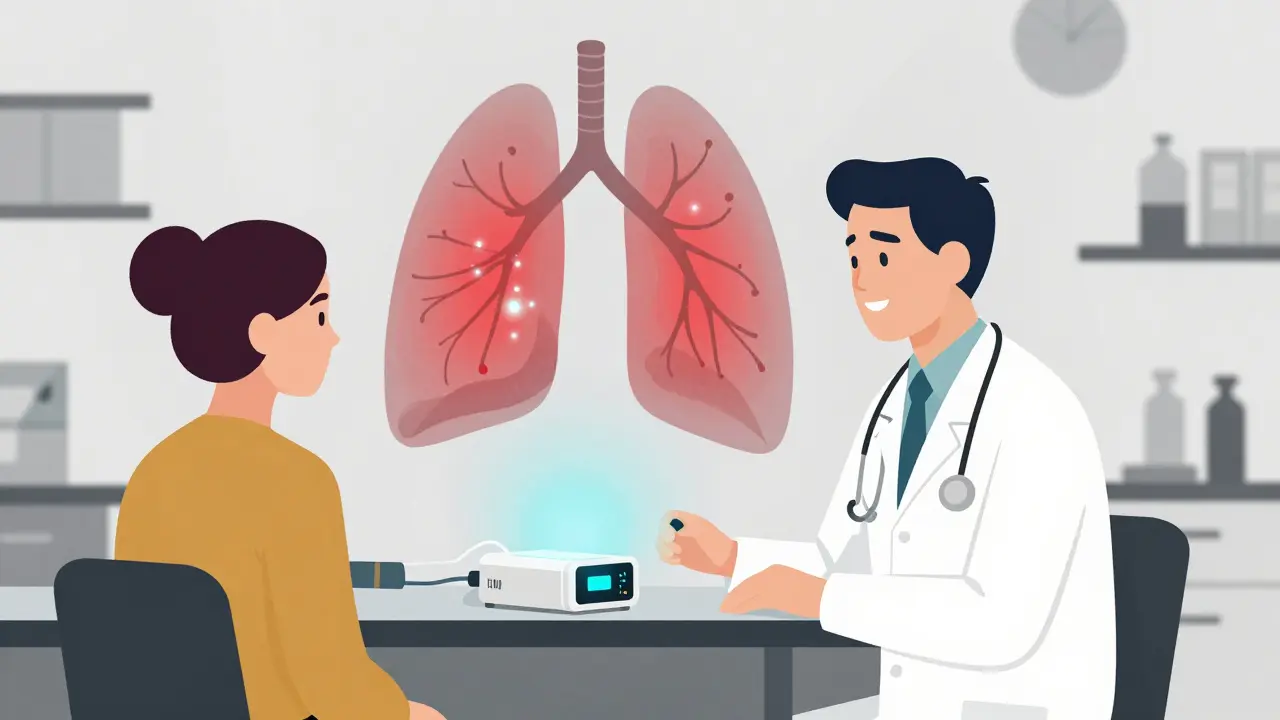
These thresholds are backed by guidelines from the American Thoracic Society and NICE. They’re not arbitrary. For example, a 34-year-old patient in Arizona had been misdiagnosed with chronic bronchitis for seven years. Her FeNO level was 48 ppb. Once her doctor saw that, they switched her treatment-and her symptoms vanished.
Who Benefits Most From FeNO Testing?
FeNO isn’t for everyone-but it’s a game-changer for certain groups:
- People with unclear asthma diagnosis (especially if spirometry is normal)
- Those who keep having flare-ups despite using inhalers
- Patients being considered for biologic therapies (like dupilumab or benralizumab)
- Children who can’t perform spirometry reliably
- People who need to know if their current treatment is working
One patient on Reddit said, “I finally had objective proof my inhaler wasn’t working.” That’s the power of FeNO. It takes the guesswork out of asthma management.
How Often Should You Get Tested?
Most guidelines suggest testing every 3-4 months if you’re on maintenance therapy. If you’re adjusting your treatment-say, switching inhalers or starting a biologic-your doctor might test you every 4-6 weeks to see how your inflammation responds. Once things stabilize, testing can drop to every 6 months.
It’s not a one-time thing. FeNO levels can change. A spike after a cold, a drop after starting steroids, a rise if you stop taking your medication-these shifts tell your doctor what’s really going on inside your lungs.
Real-World Challenges and Limitations
Despite its benefits, FeNO testing isn’t widely available everywhere. In the U.S., only 41% of community clinics offer it, compared to 87% of specialty asthma centers. Insurance coverage is patchy-only 58% of commercial plans cover it without restrictions. Some patients report being denied coverage even after multiple asthma hospitalizations.
Another issue? Technique. If you don’t exhale slowly and steadily, the reading can be invalid. That’s why modern devices like the NIOX VERO® have real-time visual feedback-so you can see if you’re breathing right. Training for staff is quick, usually under 30 minutes. But if the clinic doesn’t have the right equipment or trained staff, the test won’t be accurate.
And then there’s cost. The devices themselves range from $5,000 to $15,000. Many small practices can’t justify the investment. That’s why access is better in urban areas and academic hospitals. Rural patients often don’t even have the option.
The Future of FeNO: At-Home Testing
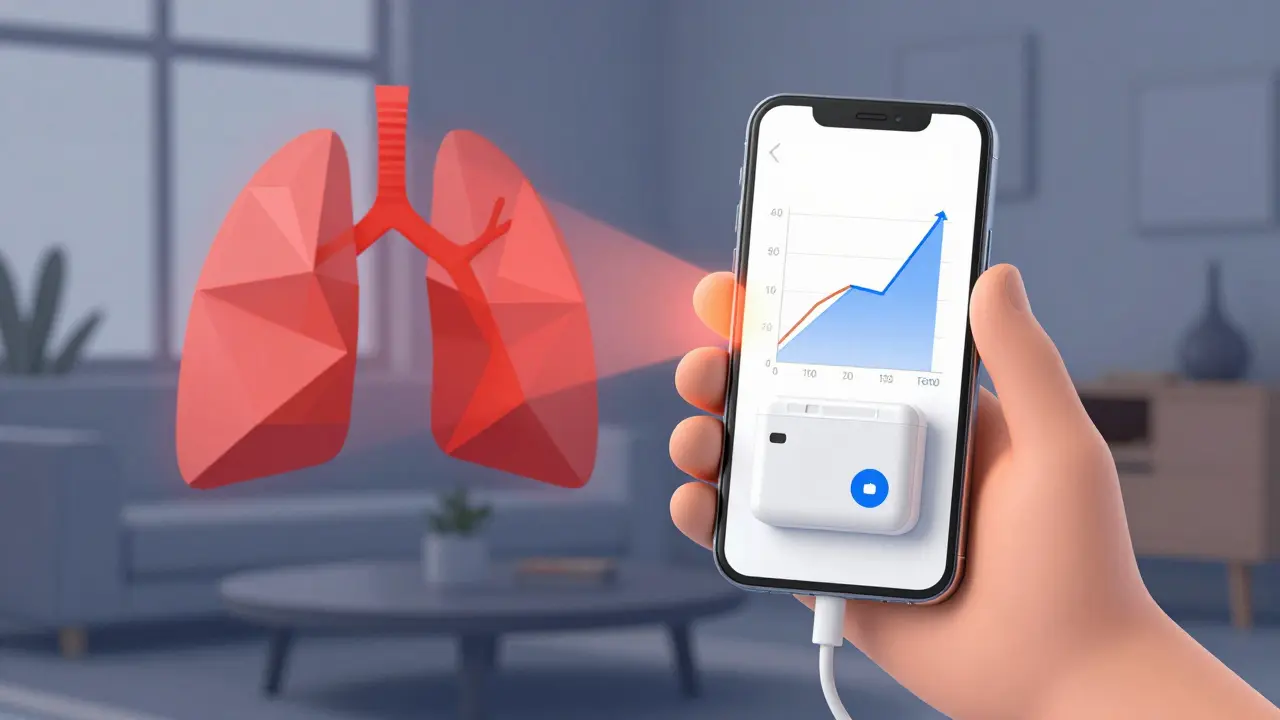
In early 2023, the FDA cleared the first smartphone-connected FeNO device: Breathometer Asthma. Priced at $299, it lets patients monitor their inflammation at home. The data syncs to an app, so your doctor can see trends over time without you having to come in.
This isn’t science fiction. In the UK, where NICE guidelines mandate FeNO availability, over 85% of clinics use it. In the U.S., adoption is growing, especially as biologic therapies become more common-and more expensive. These drugs cost $30,000-$50,000 a year. Doctors need to know who will actually benefit. FeNO helps them decide.
Researchers are now studying how FeNO can predict response to new biologics. Early results show that patients with high FeNO levels respond better to drugs like dupilumab. This could mean fewer trials, fewer side effects, and better outcomes.
What Patients Say
On community forums, 87% of users say the test was “very easy” or “easy.” Many say it gave them peace of mind. One parent wrote: “My 8-year-old used to have asthma attacks every month. After FeNO testing, we found her levels were sky-high. We switched inhalers-and she hasn’t had an attack in 14 months.”
But not everyone is thrilled. Some report inconsistent results. Others say their insurance won’t cover it. One user on HealthUnlocked said: “I had three asthma ER visits. My doctor said FeNO would help. Insurance denied it three times.” That’s the reality-access is still unequal.
Still, 68% of patients who’ve had the test believe it improved their treatment. That’s a strong vote of confidence.
Final Thoughts
FeNO testing isn’t magic. It won’t replace your inhaler or your doctor’s judgment. But it adds something critical: hard evidence. In a world where asthma care often relies on symptoms and guesswork, FeNO gives you a window into what’s happening inside your lungs. It helps answer the questions no one can see: Is my inflammation under control? Is my medication working? Do I need something stronger?
If you’ve been struggling with asthma despite treatment, ask your doctor about FeNO. It’s simple. It’s quick. And it might just change how your asthma is managed-for good.


Write a comment